Tuesday, March 22, 2011

#9 - The Maiku Hama Trilogy (1994-1996)

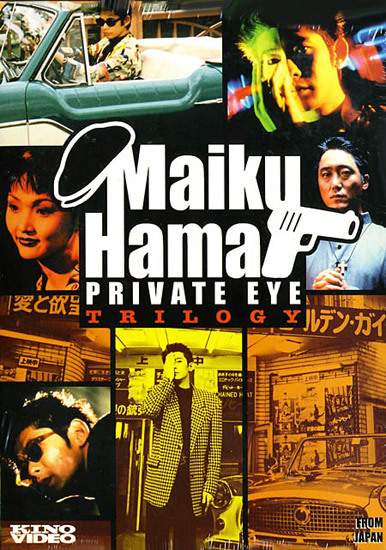
To participate in the Japanese Cinema Blogathon, I decided to abandon the double-feature format for a triple-feature:  the Maiku Hama: Private Eye trilogy. There isn't much written in English about these movies, and I hope that will change someday, because these movies are fun.


Named after the Mike Hammer character created by writer Mickey Spillane, Maiku Hama (played by Masatoshi Nagase) is a  private detective who's both comic and strangely cool, with unfashionable shirts and a beautiful yet malfunctioning American sportscar. He has connections all throughout Yokohama, though not all of them are happy to see him, and his office is located inside a movie theater - where the stingy owner demands you buy a ticket before entry.


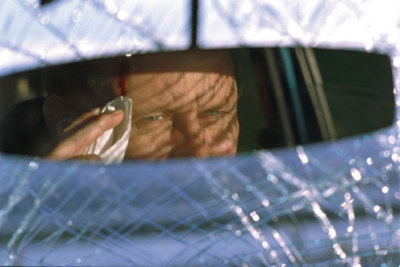
This picture's source: This great write-up on The Most Terrible Time in My Life.

This trilogy is a pastiche of numerous film tropes and references. It's often described as a parody and homage to American gangster pulp, French New Wave, and Japanese yakuza movies. However, the trilogy forms an experience totally its own. Consisting of the films The Most Terrible Time In My Life (Waga jinsei saiaku no toki), Stairway to the Distant Past (Harukana jidai no kaidan o), and The Trap (Wana), it's a bizarre combination of quirky humor and dark detective drama. It also has a catchy jazz theme song..


The character, played by Nagase, was renamed Mike Yokohama in the somewhat-connected follow-ups Mike Yokohama: A Forest with No Name (directed by Shinji Aoyama) and the TV series Shiritsu Tantei Hama Maiku.


Though all three movies were directed by Kaizo Hayashi, each film has a strikingly different tone. The Most Terrible Time In My Life is shot entirely in black-and-white Cinemascope, and starts off as an offbeat comedy about a rough-edged good guy detective with an amazing streak of bad luck. A case brought by a Taiwanese waiter brings both budding friendship and the unwelcome attention of the New Japs, a gang formed by immigrant Chinese and Koreans. The movie segues into a noir-soaked tale of loyalty, and it surprised me by exploring the subject of immigrants trying to make a living amidst prejudice in Japan. The introduction of a femme fatale into the story is initially jarring, but during the last act I found myself riveted by what was happening onscreen.


The second film, Stairway to the Distant Past, is shot in color Cinemascope. It begins with the same light tone that introduced its predecessor. Then enters the stripper Lily (Haruko Wanibuchi), the mother who abandoned Maiku Hama and his sister. At the same time, Hama finds himself drawn into the escalating political and criminal conflicts over control of Yokohama's port interests. The use of color seems to usher in a sensibility that's both more romantic and more jaded than that of the first movie. Things aren't just black and white and grey; they're complicated across the spectrum. While the violence in the first movie was made up of brutal close-range attacks, this second film goes all-out into action territory, complete with multi-level gunfights and a high-speed chase down the waterfront. Don't let this dissuade you story-minded viewers - Stairway to the Distant Past is indeed bigger in scope than the first film, but it's also more personal, dealing with Hama's own family and memories instead of those of his client. There's also a haunting scene, set amidst mannequins in a deserted alley, that serves as a taste of the movie to follow.


The Trap is my favorite entry in the Maiku Hama trilogy. Just as Maiku seems to have finally found good luck in life -business going well, wonderful girlfriend, sister doing alright- a mysterious new case brings the series into the realm of psychological thriller. Four young women are dead, looking like department store mannequins with frozen expressions and no signs of harm. The police are baffled, and as Maiku investigates the case, he finds himself considered a possible suspect in the crime.
While there are some odd bits in this installment (for example, a major gangster boss villain in the past two films is suddenly a helpful Catholic priest in this one, with no explanation), the movie maintains a high level of suspense and terror that made me forgive minor faults. This film's plunge into horror reminded me of Takashi Miike's works in that genre, but what transpires here is a breathtaking and twisted creation all its own. With a clever use of parallels and one of the scariest killers I've seen on film, The Trap is a fantastic end to the Maiku Hama trilogy.


ETA: The Yokohama Nichigeki theater featured in the movies was closed in 2005.
- - -
This post was done for the Japanese Cinema Blogathon, created to aid relief efforts for those affected by the recent earthquake and tsunami that hit Eastern Japan.

The donation page is here.
More participating blogs here.

Tuesday, January 4, 2011

2010 in media

Music, movies, books, and more.
 

Wednesday, December 29, 2010

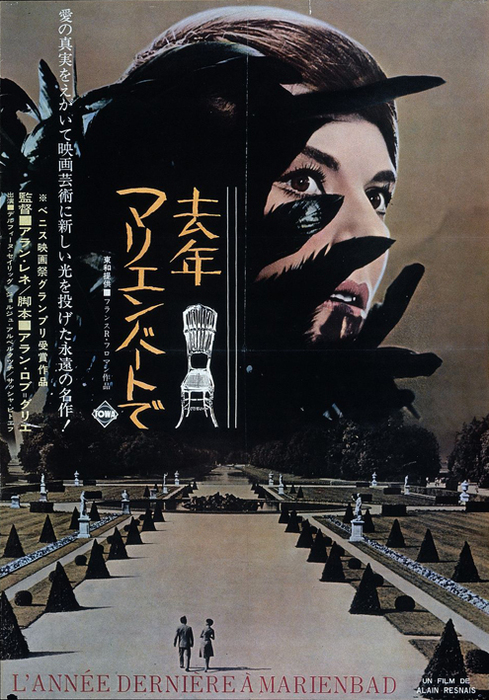
#8 - Nightmares of Mystery: Last Year at Marienbad (1961) and Carnival of Souls (1962)

Last Year at Marienbad (L'année dernière à Marienbad), directed by Alain Resnais, and Carnival of Souls, directed by Herk Harvey, are two movies you would not usually see mentioned together. However, they are both heavily stylized films from the early '60s with a protagonist who cannot figure out what is real.


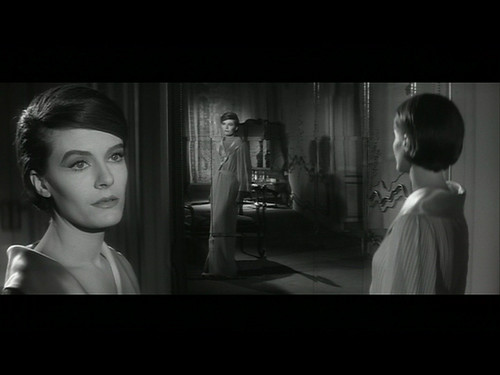
Last Year at Marienbad centers on an unnamed man (Giorgio Albertazzi) who meets a woman (Delphine Seyrig) at a European resort. He insists that they met a year before, at a resort called Marienbad, but she replies that they've never seen each other. The man spends his time trying to recall and relay his vague memories to her, and she may or may not start to remember things as well. Yet, as the connection may be a passionate one, the man must also contend with the presence of a man (Sacha Pitoëff) accompanying the woman at this resort.

Carnival of Souls opens with a car accident, killing all but one woman, named Mary Henry (Candace Hilligoss). She escapes and tries to reintegrate herself into life, but disturbing characters follow her wherever she goes.
Both the unnamed man and Mary Henry are confused about the paths they are taking, and later on start to wonder about what actually motivated them on their journeys. The only people they manage some connection with are initially presented as possible romantic interests - the unnamed woman in Marienbad, and the sleazy neighbor John Linden (Sidney Berger) in Carnival. These relationships turn dark, and in each film,, the male character builds up to an aggressive pursuit of the female character. However, their actions may or may not be figments of a troubled imagination.
Carnival of Souls is, unmistakably, a B-movie, though it is one with enough qualities to endear it to many types of film fans. The ghastly people following Mary have faces caked with white makeup, eyes surrounded with black. Some of the townspeople seem to act normal, but their actions grow more odd every moment, and there is an eerie emptiness all around Mary.

In Last Year at Marienbad, the people at the resort are all elegant in dress and refined in manner. They stop moving and start moving, either accentuating the lead character's narration or illustrating the disjointed quality of his thoughts. The composition, beautifully photographed by Sacha Vierny, is sometimes harsh in its minimalism and rigid geometry. People and things becoming little more than shapes and echoed lines. Each films have the effect of a dream spinning into nightmare.

The soundtracks, and especially their use of organ music, add to this effect. Mary in Carnival is an organist, playing crazed, infernal compositions (by Gene Moore) when the mood strikes her. The rest of the soundtrack is also played on organ, except when tunes are played on a jukebox  Marienbad composer Francis Seyrig uses the organ to create a stately yet ominous atmosphere with his music, such as when the movie opens with the main character's musings on the fading resort. On that tangent, locations in these films have both a stark beauty and an air of decay to them, from the ornate decor of that European resort to the haunting appearance of a ruined entertainment pavillion.

Last Year at Marienbad and Carnival of Souls are understandably polarizing films. Their plots can be frustrating, their looks can seem too affected, and their characters are sometimes unsympathetic or even detestable. Even for those more inclined to like these movies, it takes some time for each film's particular rhythms to set in. Yet it is interesting to compare these films for their alternate "high art"-"low art" treatments of stories told through the eyes of unreliable, alienated protagonists trying to make sense of the world. Both films aim to display feelings that cannot be competely articulated in words. They aim to be honest, in their own way; by showing these experiences as fractured and surreal, compelling and frightening for what they reveal.


-- -
Carnival of Souls for Sample Theater is a blog covering a multimedia performance of the film's story.
For more on the sets and fashion of Last Year at Marienbad, here is a great collection of screencaps, as well as writings on the film.

Last Year at Marienbad can, at the moment, be found in its entirety on Youtube.
Carnival of Souls is in the public domain and can be viewed here.

Tuesday, October 12, 2010

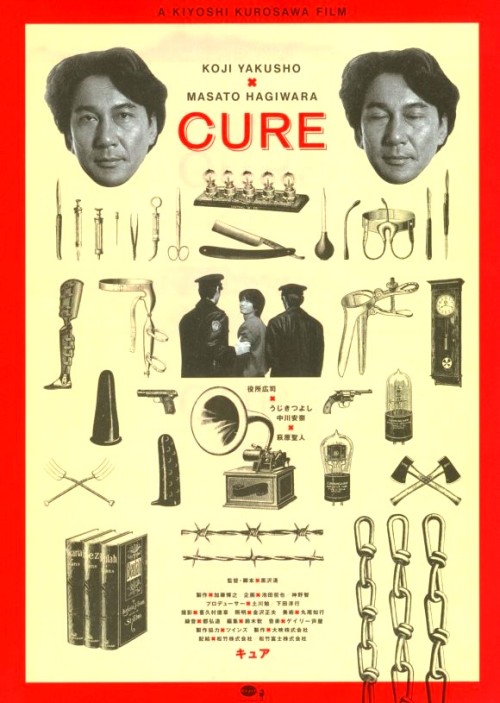
#7 - The Detective as Mystery: "Cure" (1997) and "Insomnia" (1997)

Cure, directed by Kiyoshi Kurosawa, and Insomnia, directed by Erik Skjoldbjaerg, are two mystery films from 1997. Each film begins with a murder, and ends with the consequences or implications of another murder. Both features consist of blues and grays hazy as the skies, or pristine clear like a blade's glare. This goes not only for the images on screen, but for the sentiments and choices of the characters.


Insomnia tells the story of Swedish investigator Jonas Engström (Stellan Skarsgård), who, with his partner, is called to Norway to help solve a murder. Engström is hampered by working where long hours of sun allows him little or no sleep each night. The case is further complicated when Engström must cover up his own crimes.

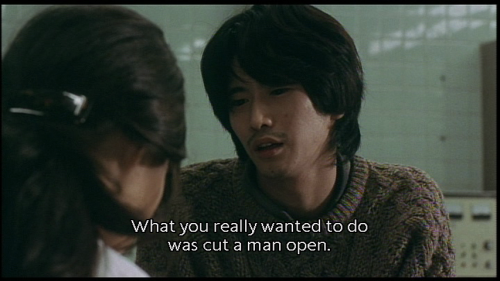
Cure follows police detective Kenichi Takabe (Kôji Yakusho) on the trail of deaths with only two things in common: an "x" carved in each victim's neck; and the killers near the crime scene, remembering nothing. Takabe is determined to find the catalyst for these shocking murders, but this catalyst may prove too dangerous for him to handle.

These detectives encounter suspects who are sly, manipulative, and sometimes enigmatically helpful. Engström's and Takabe's private desires compromise them in difficult moments.  Their relationships with women are troubled: Takabe has everyday struggles taking care of his sick wife, while the middle-aged bachelor Engström fumbles his interactions with attractive women.

Cure's psychological explanation for the catalyst's methods take on an almost supernatural aspect. The unclear tone and at times obscure details can bother those who prefer a more grounded mystery that doesn't edge so close to ridiculousness. The film is often called "dreamlike," and is elegant in its way, though the word "nightmare" better describes some of the horrific (and horror-like) events that occur.

The tensions in Insomnia center around men who wish to protect their self-interests; how these men use and abuse their skills to the benefit and misfortune of themselves and others. The film itself isn't misogynistic, but some of the characters are. Everything around the main male characters frustrates them - their living situation, the women around them, the jobs they perform. What's particularly hard for these men to admit is that it's their own faults that escalate frustrations into serious matters.

These films explore the destructive emotions seething under composed appearances. Much of each film is slow, quiet buildup, setting up shocks that are genuinely startling. Insomnia has more outright gunplay and action, while in Cure the violence -the murders are nearly all offscreen- has a lingering quality that still made me gasp several times.

Guilt and regret connect the detectives in these films, guilt for what they've done and regret for what they've failed to do.


- - -


- A remake of Insomnia, set in Alaska, was directed by Christopher Nolan in 2002.

Wednesday, May 26, 2010

#6: Framing the Everyday: "Bicycle Thieves" (1948) and "Chop Shop (2008)

I'm sorry I haven't posted in so long! I also haven't been reading much of the blogs I follow, sorry. I've just found work after graduation, and that as well as family matters (along with my obsession over a little show called Lost) consumed much of my time. I'm going to keep this post short, because I'm quite tired at the moment.

Here is the sixth double feature recommendation I have for you: Bicycle Thieves (Ladri di biciclette), directed by Vittorio De Sica, and Chop Shop, directed by Ramin Bahrani. Though separated by sixty years and set on different continents, these two films share an interest in hardworking people, in the mundane details surrounding the plot. De Sica is seen as one of the pioneers of the neorealism movement, which fostered movies that sought to show "reality" by dramatizing but not glamorizing the struggles that middle- to lower-class people face in life every day. Bahrani's film can be seen as an extension of this movement into the twenty-first century.


Posters from Tinypic and here.

Both films focus on a family that scrapes up money from whatever job they have in order to survive. While Bicycle Thieves (or, The Bicycle Thief) centers on an adult father and a young son, Chop Shop follows the plight of a pair of teenagers, an older sister and younger brother. This difference in generations means that each film contains a particular variation on the themes of responsibility and lost innocence. The plots in these films emerge slowly, taking their time to rise out of the circumstances. As for visuals, Chop Shop manages to illustrate the grayish landscape of the titular setting with vibrant color, while Bicycle Thieves gives grace to the mundane settings through lighting and composition. I'd say watch Bicycle Thieves first, to see where particular filmic interests originated.

Saturday, February 27, 2010

#5 - The Filmed Reality: "F for Fake" (1973) and "Sans soleil" (1983)

F for Fake (Vérités et mensonges), directed by Orson Welles, and Sans soleil, directed by Chris Marker, are two films that may be superficially categorized as documentaries. They film actual events; they have interviews and other features of straightforward documentary. However, these two films play with the assumed reality of the traditional objective documentary. With slips of fiction, flights of fancy, and meandering across topics and countries, these films are probably better categorized as filmed essays.


Poster sources: here and here.

Both movies, made ten years apart, take on subjects that are blurry, unreliable, and indistinct. F for Fake focuses on art fraud and the implications of the art of fakery, while Sans soleil focuses on time and memory.

Sans soleil is a travelogue of thoughts, narrated with letters from a fictional female traveler. While commenting on what she observes on her travels - through Okinawa and Tokyo, to Guinea-Bissau, to Cape Verde, to Iceland, to San Francisco - sounds and images cross and contrast. Memories blend and escape and become clarified.

F for Fake is a whirlwind in pace and personality from director/writer/narrator Orson Welles. The film seems to center around Elmyr, a legendary art forger who reproduce pretty much any work of art one can name. Yet there are multiple layers leading to and away from this center, searching to find if there are really any differences between art and forgery.

The narrators determine the tone in both features. Orson Welles is more of an overtly assertive force in his film than Chris Marker's female narrator in Sans soleil. Marker's narrator, though, is the only anchor in the cross-contintental flurry of associations; a quiet but vital guide whose opinion may be subtle but no less dominant than Welles' in the world of each film.

Both Sans soleil and F for Fake are held together by crisp editing and imagery. Sans soleil's pallette is slightly more washed out, leaning towards whites and grays and blues and browns to complement its more meditative feel. F is for fake has a wide array of colors, featuring bright sunlight and yellows and reds and vibrant shades of other colors until the more thoughtful or important sequences settle into a bluer mood.

I'd place F for Fake first in the double feature, for its surprises and more outgoing personality will have greater impact when viewed first. Sans soleil can function as an extension, a tangent of the experiences felt while watching F for Fake, and is long and varied enough to emerge on its own in the mind. What both films offer is a way to break down, but not destroy, information we process through our senses; to not so much reevaluate as better appreciate everything we hear and see.

Saturday, February 6, 2010

#4: Critics of Tradition: "Sisters of the Gion" (1936) and "Harakiri" (1962)

Sisters of the Gion (Gion no shimai), directed by Kenji Mizoguchi, and Harakiri (Seppuku), directed by Masaki Kobayashi, are two Japanese films that take a critical look at Japanese traditions that seem -for Westerners, at least- to be unquestioned, defnitive aspects of Japanese culture.


Poster sources: here and here.

Though the films are set in different centuries -Harakiri is set the 17th century and Sisters of Gion is set around 1936 - they both depict the breakdown of tradition during times of hardship in Japan's history. One film takes on the geisha establishment, while the other criticizes strict adherence to bushido. Both films feature a character who follows traditional rules and suffers, and another character who fights back and exploits the system. However, despite the negative perspectives these films display, they do posess vitality in storytelling and strong emotional appeal.

Sisters of the Gion (Gion no shimai) focuses on two sisters who are impoverished geisha in Kyoto's Gion district: the traditional and soft-spoken Umekichi (Yôko Umemura), and the more modern-minded and abrasive Omocha (the luminous Isuzu Yamada). Umekichi's client Furusawa (Benkei Shiganoya) asks for her help when he becomes bankrupt and leaves his wife. Omocha finds this exploitative and impractical. She tries to drive Umekichi away from Furusawa while searching for wealthier patrons for her sister and herself. Yet society isn't kind to geisha of little reputation, and Omocha's manipulations soon catch up to her.

Harakiri (Seppuku) is told partly through story flashback. As warrior clans are broken up and former samurai are thrown into poverty, the samurai Hanshiro Tsugumo (the legendary Tatsuya Nakadai) asks for permission to enter a daimyo home in order to honorably commit suicide. The nobles of the house are wary of this request, though, and we see the story of a younger warrior (Shima Iwashita) who had begged for work from the house.  Little do the nobles know what Hanshiro is truly seeking...

One might too simply separate Harakiri and Sisters of the Gion as male-centered action film vs. female-centered melodrama. Yet both have very intense scenes that sell some incredibly heightened situations and agendas. Both films also feature elegant compositions in black-and-white. Mizoguchi floods the sparse scenes with.sumptuous light, while Kobayashi clearly lineates the scenes for the action to come. Sisters of the Gion is more consistent in tone, since Harakiri's flashback device takes up a large chunk of time after the relatively long (and dialogue-heavy initial set-up . However, the long periods of dialogue and flashback in Harakiri effectively build up motive and intensity for the the oncoming action.

I would suggest watching Sisters of the Gion first, since it is shorter and might underwhelm after the brutal violence in Harakiri. It also helps builds up this progression: "life looks tough for women in the 1930's, especially geisha, and oh look it was tough for samurai too, even in more traditional times! whoa!"

Both films are great recommendations for those interested in Japan, especially for those who over-romanticize Japanese history and culture. They also offer damning critiques of society and gender roles, with strong plots and vivid characters. The last lines of Sisters of the Gion and one suicide scene in Harakiri will stay in my mind forever.


- - -
Harakiri can be viewed online via The Auteurs. (source)